The first self-driving company will be built on an autonomous data platform in 2027
Our predictions about what will happen in the agentic data world in the upcoming year.

Elisabeth Reitmayr
Director of Engineering
13 min read
On this page
- An autonomous data platform is a prerequisite for a superdark factory.
- The gap between AI-first companies and most enterprises keeps widening.
- Agents with curated context outperform agents with raw access.
- Data engineering extends beyond data teams.
- Security work takes time away from new pipelines.
- Ontologies establish semantic guardrails.
- Tabular foundation models make data quality checks cheap.
- The path to the superdark factory
- References
Dina leads GTM for Honeycart, a fictional small e-commerce shop. On a Saturday night in September 2027, while the whole team is offline, the shop’s autonomous data platform analyzes the day's support tickets and finds refund requests clustering around a delivery partner in northern Italy. The platform sets itself an objective: cut late deliveries in that region. It finds the partner's undocumented tracking API, requests an access token from the partner's integration agent, writes and tests a pipeline, and starts measuring. By Monday morning, Honeycart’s partner platform agreed to delivery terms with a second partner. The platform decides to move a quarter of the region's shipments to it.
Six weeks later, late deliveries no longer predict refund requests. Customers complain about damaged packaging instead. The platform's control unit opens a new objective on packaging. In the same six weeks, the platform ran eleven other experiments and stopped nine. Free express shipping in the region raised costs without cutting refunds, so the platform ended it after a week.
Most reports from this kind of experiment are not read by any of the eight employees at Honeycart. They focus on setting the hard rules the platform cannot trade away: keep customer data in the EU, trace each number in a board report to its source, stay within the compute and token budget, and set up integrations only with partners that passed a security review. They also negotiate and periodically check the norms the platform measures and adheres to, such as customer trust over short-term growth. The platform turns each norm into a metric, and trades off metrics against other goals in accordance with its self-evolving norm hierarchy. Once a week, the platform asks Dina whether one of these numbers still means what the norm suggests. This week it asks about customer trust. So far, the platform has measured trust as the share of customers who keep their order without asking for a refund. It now also proposes counting customers who get a refund and order again within 60 days, because they still trust the shop. It then proposes giving up as much as 2% of conversion to keep the refund-and-reorder rate above 30%. Dina agrees, and the platform recalculates each objective and report built on the old number.
The Superdark Factory, published in the Antikythera Journal (MIT Press), calls self-driving companies like Honeycart a class 3 factory, or superdark factory: it automates not only execution and planning but also goal setting. It represents the ultimate goal self-driving companies work towards. It negotiates norms and constraints with the people who govern it, turns them into its own objectives and metrics, keeps renegotiating those metrics, and is judged by its results.
An autonomous data platform is a prerequisite for a superdark factory.
To set an objective, a superdark factory measures its results and outcomes, like customer retention, cost, and revenue. To know whether it met the objective, it measures these metrics continuously. Each new objective needs data sources, pipelines, and checks – built, maintained, and retired faster than a team of humans ever could. Dina’s platform built the delivery tracking pipeline overnight without any human intervention.
A few small companies will build toward a superdark factory in 2027 based on a fully autonomous data platform. These companies have a very high risk appetite and work with the hungriest agentic coding talent. Most of them will be lean and recently founded.
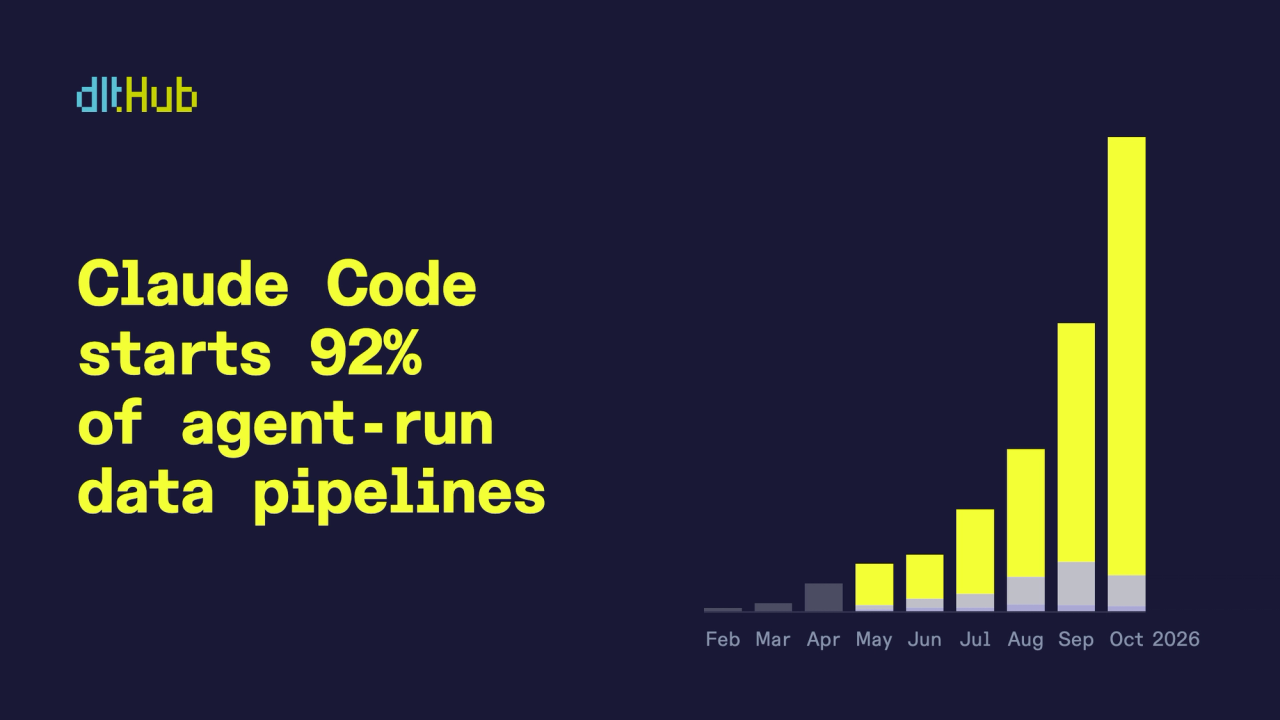
We already see early signals for the agentification of data engineering in our data. dlt users and agents have run about 28,000 custom source families since January 2025. In October, 78% of active source families were custom. A software factory generates many versions of a source throughout its experiments until one settles on the requirements. Most of those versions are throwaway code. With declarative pipelines in Python code that adapt to changing requirements, agents are far more flexible than the ~700 connectors in a managed catalog.
The rest of this post explains how we expect AI to impact data teams in 2027, and how it aligns with our product strategy at dltHub.
The gap between AI-first companies and most enterprises keeps widening.
Model capabilities keep rising: AI agents improved from 12% to about 66% task success on OSWorld, a benchmark of real computer tasks (AI Index, 2026). Any company can buy access to the top models, but higher capability alone does not translate into impact: "models post striking benchmark scores while aggregate economic output barely moves" (Evans & Weyl, 2026). Access to talent and how fast an organization adapts decide who gains. AI-first companies such as the big AI labs or Dina’s self-driving company hire most of the agentic coding talent and get increasingly productive with each model release. Most enterprises adopt new capabilities months or years later, so the gap keeps widening. Our goal at dltHub is to support organizations that cannot "jump" straight to the superdark factory stage with a step-by-step transformation based on our autonomy ladder.
Agents with curated context outperform agents with raw access.
An agent connected to raw systems through MCP works for small tasks focused on this particular system. For complex work that requires combining data from different sources and tracing an answer to its source, agents perform better with a curated layer of company knowledge and data. Dina’s platform could link refund tickets to a single delivery partner because tickets, orders, and shipments share curated definitions, and their high-level relationship is periodically confirmed with an employee, like the trust metric mentioned in the introduction.
In a 2023 benchmark, GPT-4 answered 16% of enterprise questions correctly over raw SQL tables and 54% over a knowledge graph of the same data (Sequeda et al., 2023). A 2026 benchmark comparing frontier models found the same pattern: a short document describing the dataset's measures and conventions raised accuracy from 45-51% to about 68-69% (Rumiantsau & Fokeev, 2026).
This curated layer can be a semantic layer or a gold layer of modeled tables that lives alongside the company’s knowledge base and ontology. A curated layer becomes increasingly important as teams feed agents more sources each month, as shown in our dlt telemetry data: in October 2026, dlt users and agents created 258,632 new private sources – 85% more than in September. Agents can only combine these reliably if they are curated: relationships between data sources need to be defined, and semantic definitions need to be aligned. Most enterprises have a semantic layer covering a fraction of their data, and we expect extending it to become a top priority for data teams in 2027. This curation becomes feasible using ontologies – one of dltHub’s core primitives.
Data engineering extends beyond data teams.
In 2027, most knowledge workers manage agents, and an agent works only as well as the context it receives. What we see with our customers: Data and context curation becomes part of most knowledge workers’ jobs. What we hear from our customers: Analysts and software engineers are broadening their scope, taking over data engineering work, and building pipelines with coding agents. Some analytics engineering teams are starting to own ingestion pipelines in addition to the transformations and metric definitions they report on.
One of the most successful AI companies in Europe keeps its data team intentionally lean and lets its GTM team build dlt pipelines directly, with support from coding agents and background agents. GTM teams managing the autonomous data stack match what we see in our data: 69% of marketing sources are custom, and 63% of sales and CRM sources are custom.
Security work takes time away from new pipelines.
More people building pipelines means more systems to secure, and AI keeps increasing the number of attacks. CrowdStrike's 2026 Global Threat Report counts 89% more activity from AI-enabled attackers than a year earlier. Exploit Factories keep challenging the tech world.
The number of vulnerabilities disclosed grew by 167% from January to August 2026. Source: Google
Data teams handle systems that hold and process sensitive data. In line with Patch or Die, we estimate that data engineering teams will spend twice as much time on security in 2027 as in 2026. This reduces capacity for routine pipeline maintenance work, which these teams will seek to automate. The dilemma: security incidents involving agents limit enterprises’ risk appetite, which slows this push for agentic automation. Honeycart manages risk with a hard rule: the platform sets up integrations only with partners that pass a security review. Our goal at dltHub is to enable organizations to climb the autonomy ladder step by step, guided by effective guardrails.
Ontologies establish semantic guardrails.
Besides security guardrails, agents also need guidance for assigning meaning to the data. An ontology describes the business domain: for Honeycart, these are customers, orders, deliveries, and how they relate. With an ontology in place, agents can write a canonical data model from the source schemas in one pass. Agents also draft the ontology themselves from source schemas, documentation, and queries, and a domain expert curates the relevant steps. Business and technical teams can both read it, so the ontology becomes the semantic contract pipelines are tested against. When Dina agrees to count customers who order again after a refund, the platform updates the ontology's definition of a trusted customer and tests each pipeline against the ontology, which picks up the change. Ontologies (e.g., dltHub ontologies, Genie Ontology, Snowflake Business Ontology) will become a way to operationalize norms.
Tabular foundation models make data quality checks cheap.
Each new source also needs data quality checks – these become increasingly important as human supervision of agents’ work on data pipelines decreases. We see value in tabular foundation models like TabPFN and TabICL, and fast decision models like Jev or Liquid AI’s d1-ultra, to achieve high coverage in data quality checks without writing all tests manually. Tabular foundation models predict values and classify rows in tables based on a pre-trained model. They can generate a full set of data quality checks for a new source before they have enough history to tune thresholds. Data users can validate checks and thresholds suggested by the model. Per-row semantic checks, such as whether a delivery’s recorded transit time is plausible for its carrier, route, and parcel size, become cheap enough to run in each pipeline.
At Honeycart, the autonomous data platform runs this check as a filter step while loading delivery data, before measuring late deliveries. The models route doubtful rows to an agent or person, depending on severity. With cheap checks and evals, teams automate more pipeline work and keep quality guardrails in place.
The path to the superdark factory
The superdark factory depends on autonomous data engineering. In September we described a four-level autonomy ladder for data platforms, from assisted authoring to governed autonomy for known failures. In The Superdark Factory’s terms, these four levels cover part of class 1, which automates execution: people still define plans for the platform. A class 2 factory also makes its own plans, and a class 3 factory sets its own objectives. Most data teams will work at levels 1-2 in 2027, and we build dltHub for them. A few very advanced AI-first companies like Dina’s climb to class 3. We will soon share more about our own work on a data factory – stay tuned!
Automating a data platform takes work at each stage. Our predictions above describe what enterprises can build in 2027 on the way to a fully autonomous data platform: curated context, democratized data engineering beyond data teams, ontologies as guardrails, high coverage for data quality checks, and automated pipeline maintenance.
References
Brudaru, A. (2026). Ontology engineering: what it is, why it's back, and why agents need it. dltHub, 5 May 2026.
CrowdStrike (2026). 2026 CrowdStrike Global Threat Report: AI Accelerates Adversaries and Reshapes the Attack Surface. Press release, 24 February 2026.
de la Garza, J., & Lackey, Z. (2026). Patch or Die. a16z, 23 October 2026.
dltHub (2026). Explore and Transform your data with dltHub AI Harness. dltHub Docs.
Evans & Weyl, E. G. (2026). In the image of their tools. Science, 394(6824).
Google Threat Intelligence Group (2026). Vulnerability discovery and exploitation trends in the AI era. Google Cloud Blog.
Hollmann, N., Müller, S., Purucker, L., Krishnakumar, A., Körfer, M., Hoo, S. B., Schirrmeister, R. T., & Hutter, F. (2025). Accurate predictions on small data with a tabular foundation model. Nature, 637, 319–326.
Liquid AI (2026). d1-ultra: Introducing the World’s Best Decision Model. Liquid AI, 15 October 2026.
O'Brien, J. (2026). Exploit Factories. Subconscious, 22 October 2026.
Poliks, M., Alonso Trillo, R., Dunn, T., & Scott-Douglas, H., Springett, J. (2026). The Superdark Factory: Toward the Full Automation of Software. Antikythera Journal, MIT Press, DOI 10.1162/ANTI.AW01.
Qu, J., Holzmüller, D., Varoquaux, G., & Le Morvan, M. (2025). TabICL: A tabular foundation model for in-context learning on large data. ICML 2025.
Reitmayr, E. (2026). Towards a Self-Improving Autonomous Data Platform. dltHub, 15 September 2026.
Rumiantsau, M., & Fokeev, I. (2026). Semantic Layers for Reliable LLM-Powered Data Analytics: A Paired Benchmark of Accuracy and Hallucination Across Three Frontier Models. arXiv:2604.25149.
Sajadieh, S., Fattorini, L., Perrault, R., Gil, Y., Parli, V., et al. (2026). Artificial Intelligence Index Report 2026. Stanford Institute for Human-Centered AI. arXiv:2606.15708.
Sequeda, J., Allemang, D., & Jacob, B. (2023). A Benchmark to Understand the Role of Knowledge Graphs on Large Language Models' Accuracy for Question Answering on Enterprise SQL Databases. arXiv:2311.07509.
Snowflake (2026). Snowflake Helps Enterprises Deploy AI Agents with Trusted Business Context and Built-In Controls. Press release, 3 November 2026.
Sundell, S., Wong, K., & Georis, E. (2026). Introducing Genie One, Genie Agents, and Genie Ontology. Databricks, 16 June 2026.