dltHub is now pay-as-you-go: start at $10 per runtime hour, commit when you have the proof
From today we sell dltHub two ways. Pay-as-you-go: $10 per runtime hour, billed by card, no minimum spend and no contract. Annual Commitment: a yearly contract with volume discounts and enterprise features. Every team starts with a 14-day free trial and $30 in credits.

Matthaus Krzykowski
Co-Founder & CEO
5 min read
From today we sell dltHub two ways. Pay-as-you-go is for teams that want to start now: $10 per runtime hour, billed by card, with no minimum spend and no contract. Annual Commitment is for teams that run dltHub at scale: a yearly contract with volume discounts, multiple workspaces and enterprise features such as an SLA, bring your own cloud and audit logs. Every team starts with a 14-day free trial and $30 in credits, and chooses a plan when the trial ends.
Until now, running pipelines on dltHub started with a sales conversation and a yearly contract, which works for larger teams that already know what they need. We built pay-as-you-go in response to what you told us in recent weeks. Two groups asked for it more than any other: lean teams and consultants who run data without a data engineer, and data engineering teams who need proof before they commit.
Two types of teams asked for this
You run the data for a team that has no data engineer
You might be an analyst who runs ingestion for the marketing team, or a consultant or fractional data lead who loads Shopify, Meta Ads and Postgres into Snowflake for several direct-to-consumer brands. You build your own connectors with an agent in the dltHub AI harness, and often you build agents on top of that data. Under row-based pricing, every extra endpoint raises the bill. With dltHub you pay for runtime and choose how often each pipeline runs, so the bill stays predictable. Each new client adds a pipeline and a bill you can estimate up front, with no contract to negotiate. Pay-as-you-go can be your long-term plan with dltHub, not only a way to start.
You have to prove it before anyone signs
You know what you want to change, and you need to convince others first: a CEO, a CIO, legal, procurement or finance. A trial shows you that dltHub works. Pay-as-you-go shows them what it costs to run. There is no end date and no credit cap, so you can run your real sources on their real schedules for as long as you need, and build the case with real numbers: a bill next to what you pay today; how fast and how often a NetSuite or Oracle source loads; that an agent can build the source no vendor covers; and what your AI spend returns, with model usage and cost from Anthropic and OpenAI next to your business data.
In health and finance, you can run the pipelines on real systems first and add the security review when you move to an Annual Commitment. The work you did to set up the pipelines carries over.
Production pipelines without a platform team
Pay-as-you-go provides the same core benefits as the full dltHub platform.
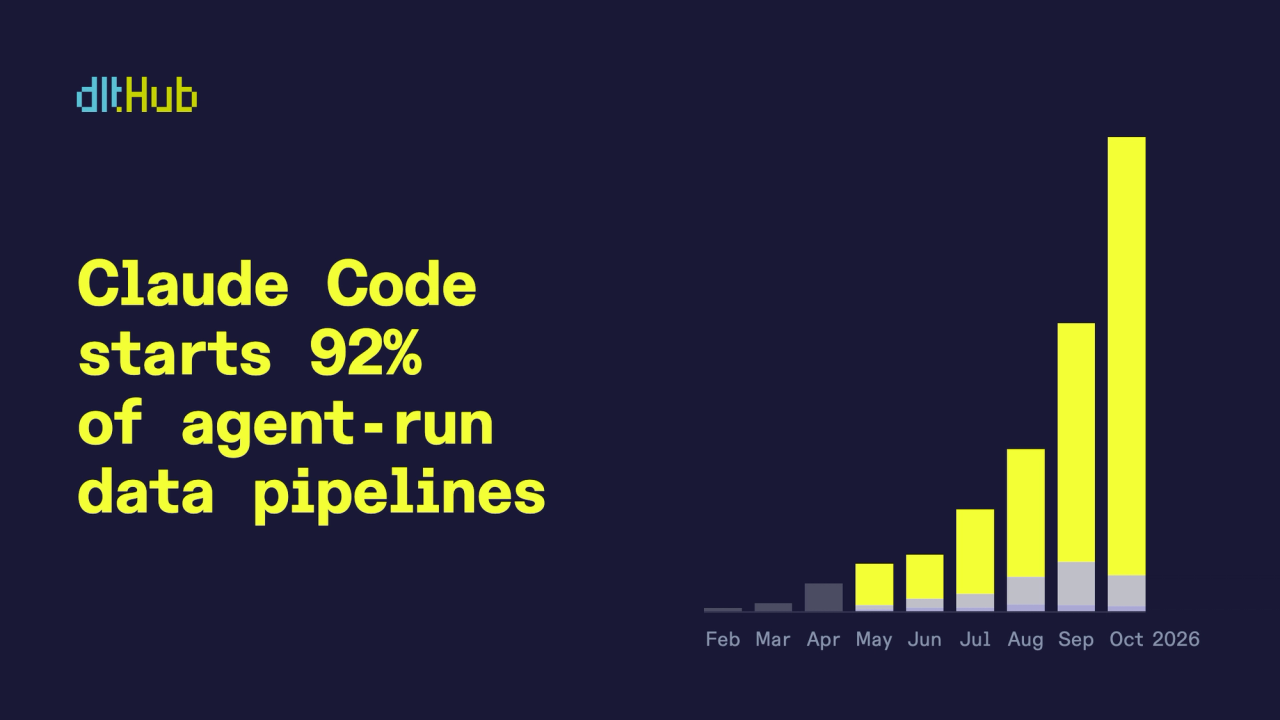
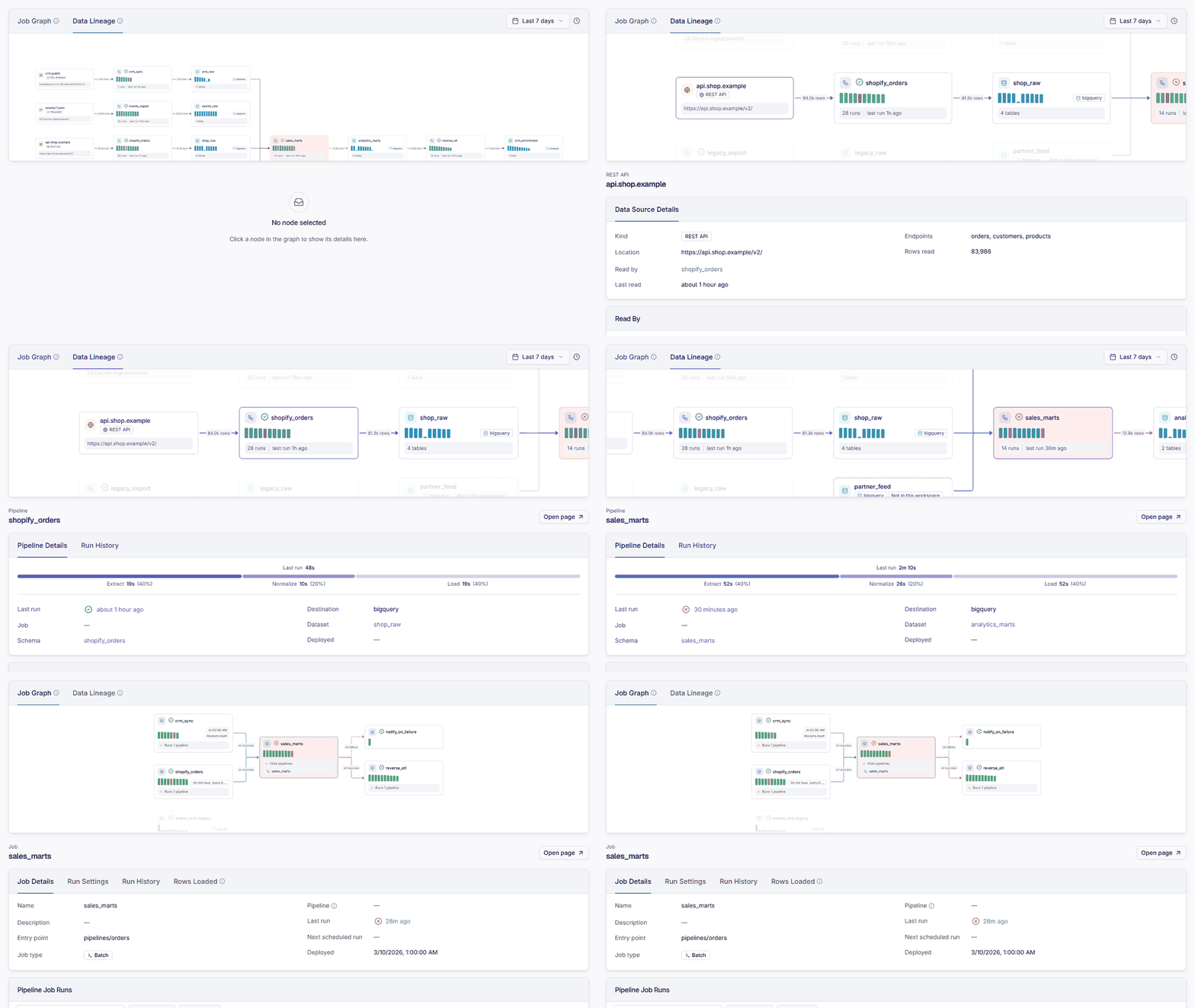
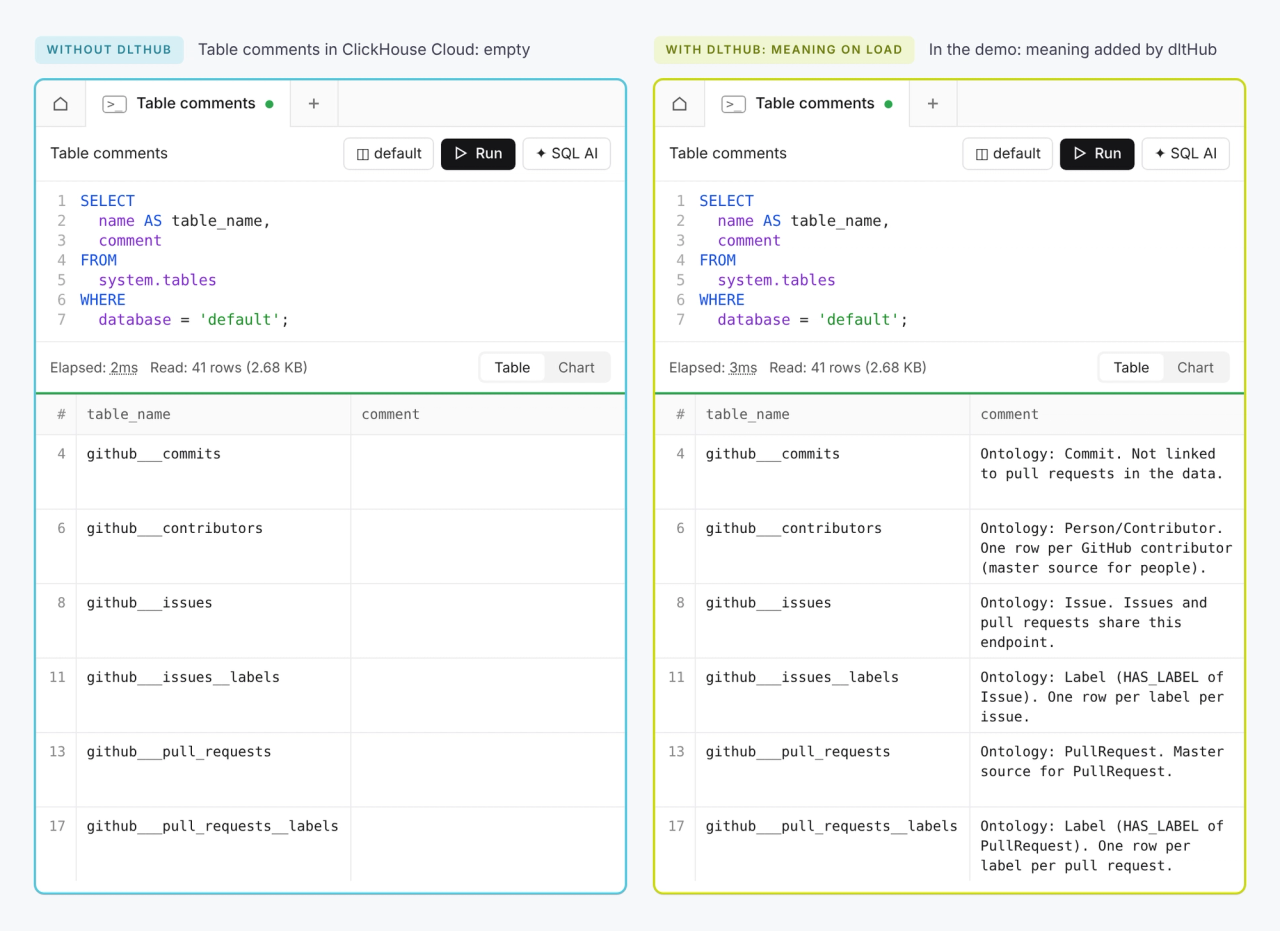
dltHub is the agentic and managed layer on top of the warehouse you already use, whether that is Snowflake, BigQuery or Databricks. The AI harness gives Claude Code, Codex or Cursor the skills to build a pipeline for any source, including an internal API no vendor covers. The runtime runs it with orchestration, scheduling and observability built in, and background agents look after pipelines and data quality between runs. Every pipeline is open-source dlt code that stays yours.
Agents can build a pipeline for an internal API or a niche tool as easily as for a common SaaS source. Every pipeline is open-source dlt code, so it runs anywhere and stays yours. Data quality checks, schema contracts and PII redaction run before data reaches the warehouse, and every run shows up in pipeline health dashboards and alerts. It is all built on dlt, the open-source library 22,000+ companies use in production.
What it costs, and how to explain it to finance
A DTC brand that loads Shopify, Meta Ads, TikTok Ads, Google Ads and its Postgres database, mostly once a day, pays about $80 a month. An AI company with about 20 pipelines for call recordings, CRM, billing, support tickets and model cost APIs, where calls and tickets load as they arrive and the rest daily, pays about $800 a month. You choose how often each pipeline runs, and that sets the bill.
Pay-as-you-go has one unit: the runtime hour. You pay $10 for each hour your pipelines run on the default instance, and that price includes the managed runtime, orchestration and monitoring.
You can estimate the cost before you commit. The cost estimator skill in the AI harness runs on your trial pipelines and produces a PDF estimate with its assumptions, ready to share with finance. Once you are running, usage alerts email the people you choose when usage passes the threshold you set. If the bill is higher than you want, run pipelines less often or load only what changed.
When you are ready to commit for a year
Many teams will stay on pay-as-you-go. You are ready for an Annual Commitment when your usage is steady or growing, when you need separate staging and production workspaces, SSO and SCIM, audit logs, bring your own cloud or an SLA, or when your company needs a security review, a procurement process or help with migration. Annual Commitments come with volume discounts on committed spend, so if you run more than about 120 runtime hours a month, talk to us. Everything you built on pay-as-you-go moves with you.
Start on your own data
Start a free trial: 14 days, $30 in credits, no card needed. Ask your agent to build a pipeline for one of your sources and run it for a few days. If you run data for a team or for clients, choose pay-as-you-go when the trial ends. If you need to make the case first, take the cost estimate to finance, then choose pay-as-you-go or talk to us about an Annual Commitment.
See the details on the pricing page.