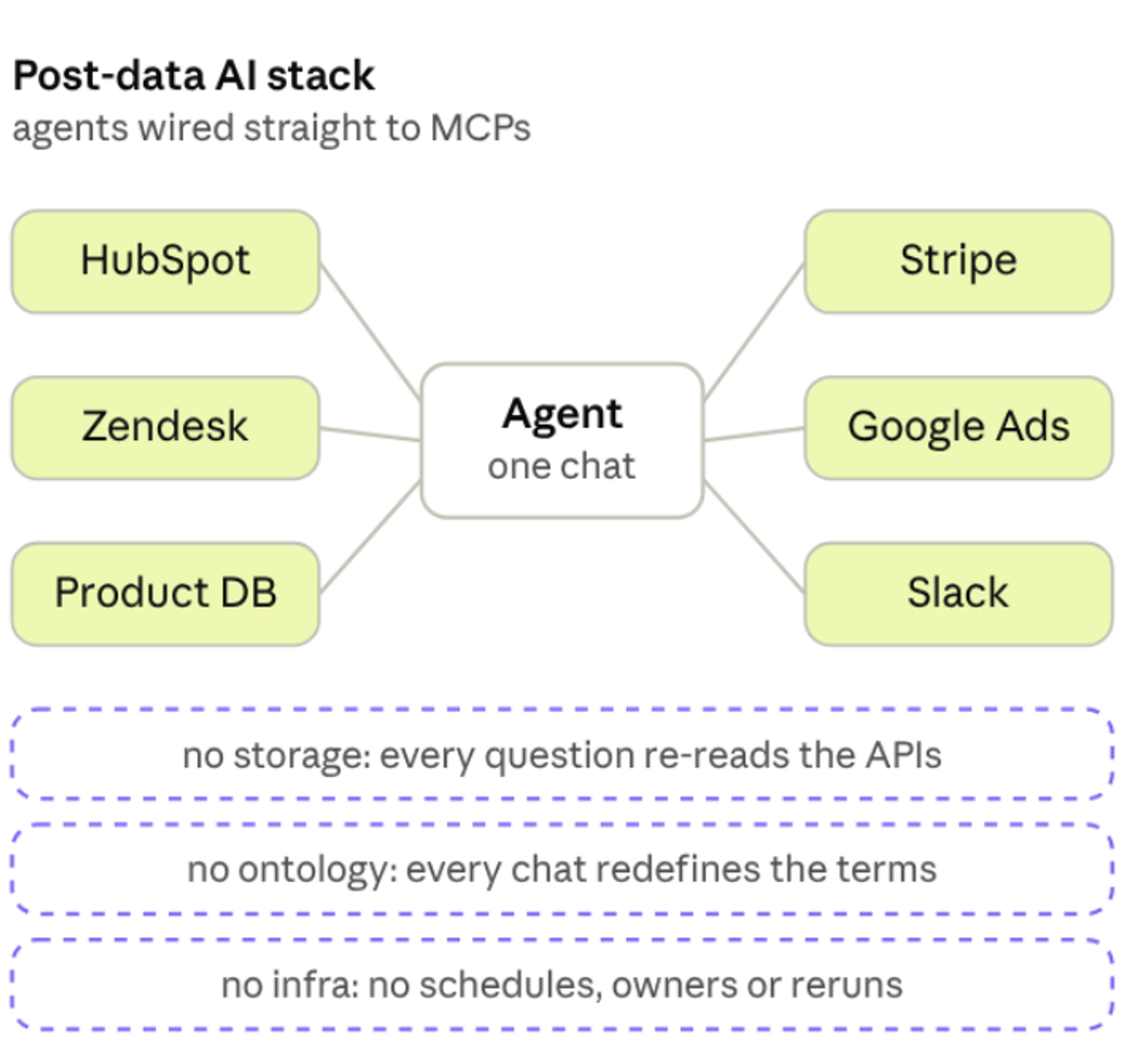
MCP on raw data is just Excel hell again
Agents replaced the analyst, not the warehouse. Wire them straight into raw systems and you get Excel hell at machine speed: two teams, two revenue numbers.

Adrian Brudaru
Co-Founder & CDO
5 min read
Your team just plugged an AI agent straight into MCP to Salesforce, Stripe and HubSpot.
The demo was impressive: ask anything, get an answer in seconds.
The CFO asks it for last quarter's revenue: $1.2 million. Sales asks the same agent the same question: $1.4 million.
The board wants to know which number is real, and nobody can say, and it feels like we’re back to pre-data warehouse days when each department had their own heuristic for the numbers in some excel sheet.
Remember the analyst?
Before agents, when the CxO asked a question the analyst answered it. The analyst knew what "active customer" meant, which table to trust, and which rows to throw out. That's data literacy, the ability to connect the highly semantic but imprecise human language to a precise SQL query.
Behind the analyst sat the data warehouse, where the business rules lived as code.
The analyst brought the semantics and the warehouse brought the precision.
You needed both, and you still do.
If an analyst or stakeholder skipped the warehouse and went straight to raw data Excel exports? Every one of them counted differently, and no two reports agreed. That mess is the main reason “singe source of truth” org warehouses exist.
Agents replaced the analyst, not the warehouse
The agent is the new data literacy layer. Its knowledge of the business is written down as an ontology: a map that connects the semantic business world to the precise data location and definition.
But the agent still needs a “single source of truth” to stand on. The business rules still have to live in code. The only change: they now span many sources, not one database.
Why raw MCP feels great, until it doesn't
Skip the precision layer and you're back in Excel hell. Analysts used to pull a CRM export into a spreadsheet and rebuild the rules by hand. Now agents pull from a CRM MCP and guess the rules from raw tables.
It's worse this time. A raw MCP often comes with write access, so a wrong guess can change your data, not just a report.
So why does raw MCP feel fine? Because for one person, it works. The operator is their own analyst with their own rules, and doesn't feel the pain. The pain shows up between departments: finance and sales each run a private analytics layer, and nobody shares a number. Raw MCP is fine for single-player work. A company isn't single-player.
Why not just tell the AI the precision rules?
Yes of course! Why not? we just have to write them out very precisely, in a way that leaves no room for doubt, such as in code. And then we would ideally want to pre-execute the big math so we don’t wait 3 hours for an answer that gets calculated at query time.
And then we have a data warehouse.
| Human language | Code | |
|---|---|---|
| Good at | Meaning, context, intent | Exact rules, every time |
| Bad at | Precision at scale | Explaining why |
| Use it for | What "customer" means | How revenue is calculated |
So what actually works?
Build two layers, and put them in your platform catalog, where governance already lives. Not in a new tool.
- Meaning layer (ontology). The business dictionary agents read: what a customer is, which revenue counts, and where each lives in the data.
- Precision layer (code). The business rules as tested code, across all sources. Same answer every time.
Agents can still use MCP, just through tools mapped to the meaning layer instead of straight onto raw systems.
The meaning layer is already supported on major platforms. Databricks has Unity Catalog Business Semantics and Genie Ontology. Snowflake has Semantic Views and governed MCP servers.
One question for your next agent demo
Agents don't remove the need for a single source of truth. They make it urgent, because a wrong answer now arrives instantly and sounds confident.
- Agents replaced the analyst, not the warehouse.
- Meaning goes in your platform catalog. Business rules stay in code, now across many sources.
- Skip that and you get MCP on raw data: fine for one person, Excel hell for the company.
So next time someone demos an agent wired straight into your systems, ask one thing: when the CFO and sales ask for revenue, will they get the same number? If the answer is "probably", you're looking at Excel hell with a chat window.
Where does dltHub fit here?
Where dltHub fits
dltHub fills both layers, inside the tools you already have.
- Pipelines built to match the meaning. dltHub’s AI harness reads your business definitions from your catalog, then builds the dlt pipeline, the model and the metric view to match. The rules end up as Python in git, so every change is a reviewable diff.
- Meaning kept where governance already sits. What dltHub builds goes back into your catalog’s meaning layer. New terms go out as proposals for people to approve. No second governance layer, nothing new to own or audit.
- Cost paid once. The work happens at build time, not on every question.
You can try dltHub from the main page builder prompt. Want help to bring it to your platform? Contact us.