Consulting is becoming software.
dltHub ships four Migration Blueprints: Python scripts, dlt, Fivetran, and Airbyte to dltHub. LLM-native tooling turns multi-month, senior-only migration projects into weeks of work at a fraction of the cost.

Matthaus Krzykowski
Co-Founder & CEO
4 min read
On this page
Today we ship four Migration Blueprints: Python, dlt, Fivetran, and Airbyte → dltHub.
If you decide the data engineering tooling for your team, a migration has always been the hardest call you make: months of your most senior engineers' time, a six-figure consulting quote, and a bet that the pain of staying beat the pain of leaving. So most teams stay.
LLM-native tools change that math for you. The work that used to require senior engineers (reading the old pipelines, mapping the schemas, rebuilding the logic, validating the output) can now be codified into skills an agent runs, overseen by the engineers you already have. A senior-only, multi-month project becomes weeks of work at a fraction of the cost. Migrations and infra upgrades are one of the clearest cases: the engagement becomes software.
Today we ship an initial set of four dltHub Migration Blueprints:
ETL vendors are pricing as if you can't leave
We keep hearing the same pattern from technical managers: 2-3x price increases at renewal, concentrated on accounts running 30+ pipelines. The logic is that at that scale, migrating costs more than renewing, so most teams renew.
At the same time, AI budgets are growing while ETL/BI budgets stay flat. Teams running 30+ pipelines are paying more each year for tooling they've assumed is too costly to replace.
Migration Blueprints change that assumption by lowering the cost of moving.
dlt is the match between standardization and customization
Ingestion tooling sits on a spectrum from standardization to customization. Which end fits you depends on who maintains your pipelines and what your stakeholders need.
Raw Python scripts sit at the customization end: infinitely flexible, and nobody wants to maintain them, especially now that Claude, Cursor, and Codex generate them by the thousand. Historically 70% of the people who became dlt users were writing Python first. With coding agents everywhere, that share is only growing.
Fivetran, and to a lesser extent Airbyte, sit at the standardization end: managed connectors behind a GUI. If a technical decision maker needs GUI-centric tooling covering a short list of connectors for business stakeholders, that's what we tell them to pick.
dlt is the match between the two extremes: the standardization of a managed tool with the customization of code you own. dlt has standardised 90% of data engineering tasks in Python code in a way LLMs can understand and humans can still maintain.
Two kinds of migration: from Python, or from a vendor
Pythonic migrations. Python scripts → dltHub is the most common pattern we see now, driven by the rise of Claude, Cursor, and Codex. You keep your custom logic and gain schema evolution, observability, and a runtime that ships to production. dlt → dltHub takes the open-source project you already trust and puts the platform underneath it.
Vendor migrations. Fivetran → dltHub and Airbyte → dltHub move you off managed connectors that break when a column changes, and off the renewal pricing above, without giving up coverage.
Why dltHub, not dlt plus your own skills
Many consultancies already run migrations with dlt and their own Claude skills. That works. dltHub adds one thing that's hard to reproduce on your own: a persistent context layer.
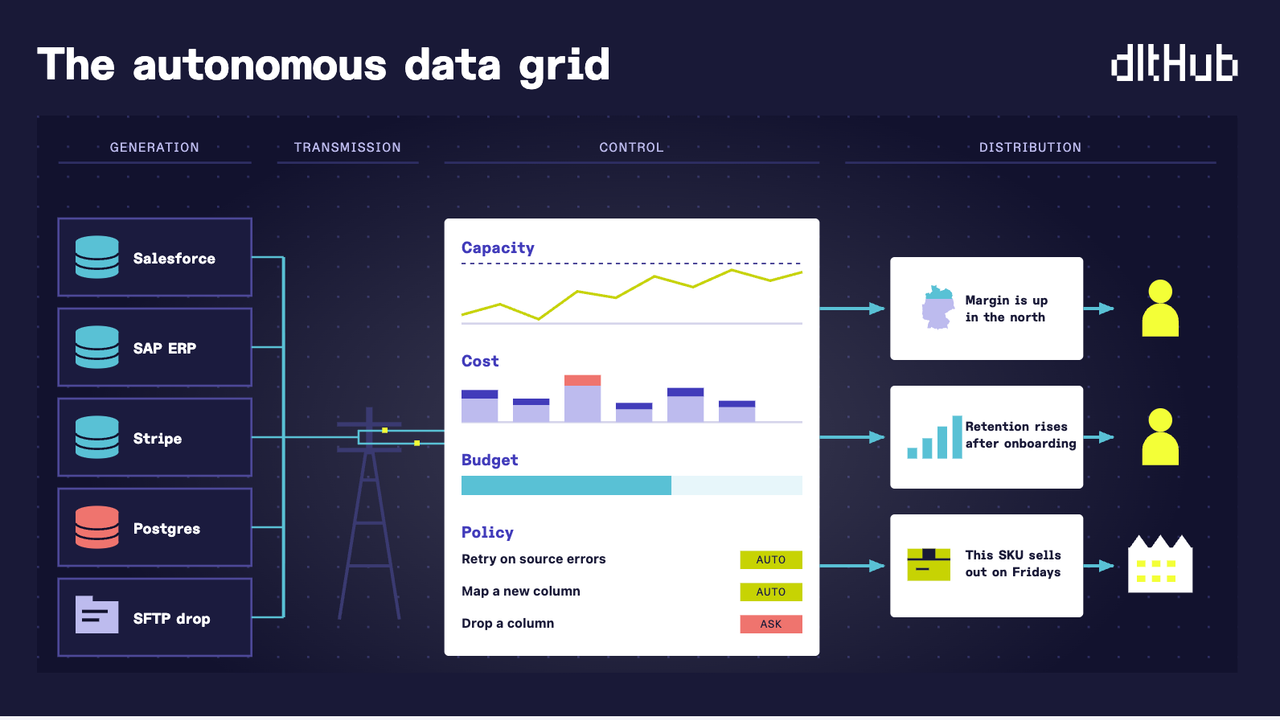
Most stacks discard context at each boundary: schema at ingest, joins in transform, lineage in the orchestrator. By the time an agent runs, the information it needs to reason about the pipeline is scattered or gone. dltHub captures it continuously (schemas, lineage, traces, and runtime state) across the whole pipeline, and keeps it in one place the agent can read from and write to, ingest to deploy.
Skills and MCP are common now; their output is only as good as what they can read. With a complete, current context layer, the same Claude, Codex, and Cursor prompts you already use produce better results, because the agent reads the actual state of your pipeline instead of reconstructing it.
You run all of this in the dltHub, LLM-native tooling that ships with agent configs for Claude, Codex, and Cursor.
How to get started
Bring us a stack you want to move. We go on a scoping call, then send you a proposal. When we have capacity, we can move 30 pipelines in two weeks.
Are you a consulting partner? We increasingly run Agentic Migrations together. Reach us through the same contact form.