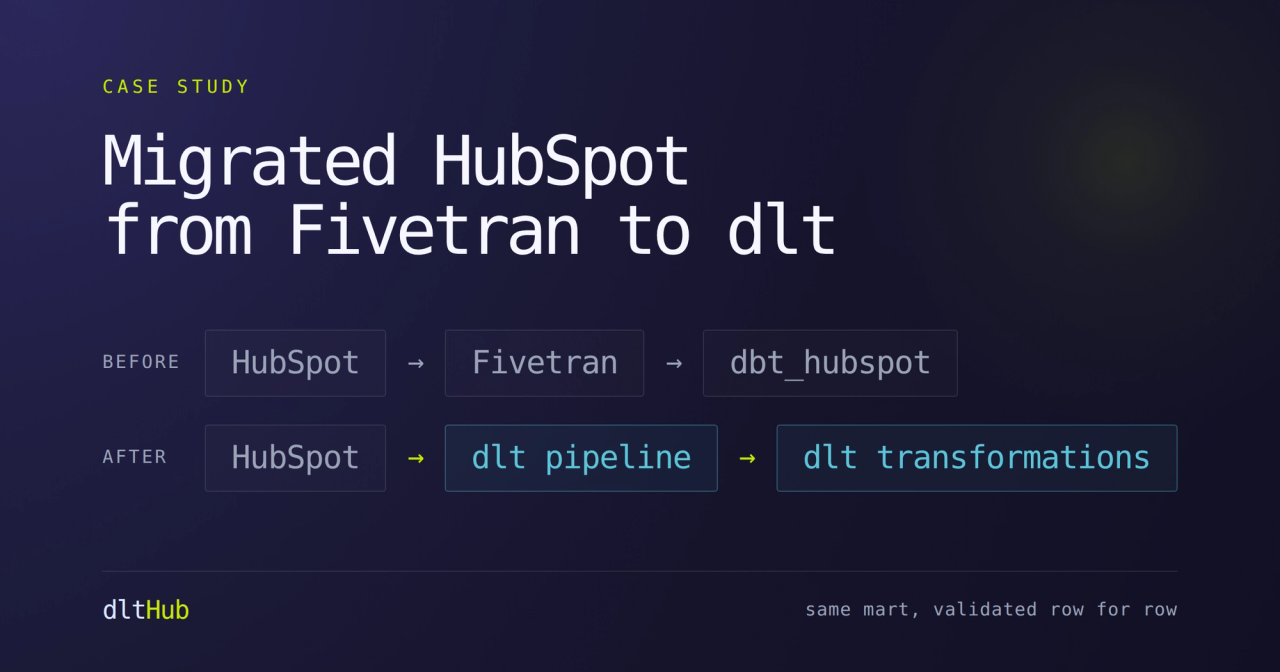
Migrating from Fivetran: how the move actually works
What does the move do to my bill and my renewal? And how to move?

Adrian Brudaru
Co-Founder & CDO
5 min read
There are usually a few reasons companies migrate off of fivetran
- The rising cost, a bill shock, or rising team capabilities made you decide to take control.
- You’re a larger account that recently saw significant price increases
- You tried dltHub for a diy connector/customization, liked it, and decided to lower your TCO by migrating everything else.
Regain control of your billing by paying for infra, not rows.
You want to pay for infrastructure, not rows. You’re already paying for the rest of your pipeline that way: whether you’re purchasing from snowflake, databricks, aws, gcp or azure, you’re paying for the unit of compute, so why keep paying royalties for the easy part?
When you stop paying royalties per row and instead pay for compute, your bill typically drops 10-100x. To give a simple example, we benchmarked what 1h of dltHub can move.
For reference, an hour of dltHub is priced at around $1. Here’s the equivalent cost depending on different types of sources:
| Case | Bottleneck | One hour ($1) of dltHub moves | Cost on Fivetran (estimate) |
|---|---|---|---|
| Parquet files | memory and I/O | ~170 GB · ~1.1B rows | ~$5,737 |
| SQL (Postgres) | network and serialization | ~65 GB · ~350M rows | ~$4,131 |
| JSON files | CPU, type inference | ~4.6 GB · ~47M rows | ~$2,317 |
| REST (HubSpot, GitHub) | the source's rate limit | whatever the API allows — ~225–275k rows/h in these runs | ~$116–141 (fits in the free tier) |
The take-away is clear - paying for compute instead of rows saves around 99% of your running cost.
Let analysts self-serve, keep your SLAs, stop waiting on the catalog
Lack of control over connectors often leads to waiting times and workarounds. Modern teams choose AI-augmentation to bring in engineering capabilities like coding. This works! LLMs can write pipelines, but how well?
- The pipelines have 99.83% reliability: Today, over 90% of new dlt pipelines are generated by LLMs. We observe them to run in production with 99.83% reliability in the wild - a human maintenance event every 2 years. (calculated on recent 50m production runs)
- Their generation is mature and secure: With the dlthub context, the agent applies senior engineer behaviors like not leaking credentials, testing, and ensuring code quality.
- Their maintenance is fast and easy. with dlthub context, agents can read logs, deployments and your code, test locally on dev and propose a fix - all your team has to do is approve or steer.
Read more about the dlthub total cost of ownership here.
Empowering your team to customisation.
Fivetran sponsored an independent bake off between their SDK and dlt without skills in agentic building. dlt skills were held back for balance.
The outcome was surprising and it reflects core quality differences between the tools that go much deeper than their agentic capabilities.
In this experiment the tools were challenged with a schema change including null primary keys - a breaking condition.
- dlt broke on breaking changes (null primary keys), handled the non breaking changes graciously, loading clean, ready to use data
- Fivetran simply discarded the rows silently, and converted mixed types into text, hiding half of the problem and moving the other half to you.
| Fivetran SDK | dlt | |
|---|---|---|
| Records loaded | 2,815 / 3,000 | 3,000 / 3,000 |
| Records lost silently | 185 / 3,000 | |
| Data cleaning | normalisation not done, JSON strings in VARCHAR | clean, typed, join-ready child tables |
| Mixed types | flattened to strings | typed variant columns |
| Failure mode | silent drop | broke loudly once, agent repaired it |
| Run status | incorrectly reported success | broke on breaking changes, reported error, agent fixed |
Let me spell it out: One tool applies senior best practices, the other does not pass the junior bar.
The cost of moving
First, an offer for assistance - bring us the stack you want to move - when we have capacity, we can move 30 pipelines over a two week timeline.
If you have the talent in house to help you move, senior engineers report moving at around the rate of 1 connector per day. For example, at one of our dlt community meetups (before our managed offering), a CTO presented how he migrated in 5 days - and this was without the faster-better dltHub agentic context.
$100/connector/year ongoing TCO
dlt in the wild is observed to be 99.83% successful. This translated into a maintenance event every 2.2 years. With agentic maintenance, this cost drops further. Overall, it averages out to around $100 worth of human labor and peanuts in llm tokens ($2-5)
Read more about the dlthub total cost of ownership here.
Why dltHub, not dlt plus your own skills
Many consultancies already run migrations with open-source dlt and their own Claude skills. That works, and it takes a good platform engineer or data engineer to operationalize it well.
dltHub makes the outcome a property of the platform instead of the person.
Most stacks lose context at every boundary: schema in the ingest tool, lineage in the orchestrator, history in the logs. dltHub keeps it all in one place, ingest to chart: schemas, lineage, traces, transformations, quality checks, notebooks. That one record is what the agent works from, and it's what the benefits cash out of:
- Lower TCO — with agentic maintenance that can instantly read logs, fix the code, test in dev and let the human know the outcomes before asking for deployment confirmation.
- Anyone can operate it — the context travels with the pipeline, not with the engineer who built it.
- Best practice by default — we maintain the skills, so pipelines run at the current best standard of our tool implemented “as intended by the manufacturer”.
- Safe by design — the agent reads prod, tests in local dev, and ships only with your approval; quality checks catch drift before it propagates.
With DIY skills, each of these is a maybe. The pipeline cost is similar either way — what differs is everything around it. Skills you can rebuild in an afternoon; the context only exists if something has been accumulating it all along.
Ready to move?
Book a call with our team or try dltHub yourself today.