We are launching two dltHub Blueprints for agent spend: Agent Cost & Usage to understand it, Agent Distillation to optimize it
dltHub launches two Blueprints for agent spend: Agent Cost & Usage to break down what each model, person, and customer costs, and Agent Distillation (with distil labs) to replace expensive agents with cheaper specialist models.

Matthaus Krzykowski
Co-Founder & CEO
6 min read
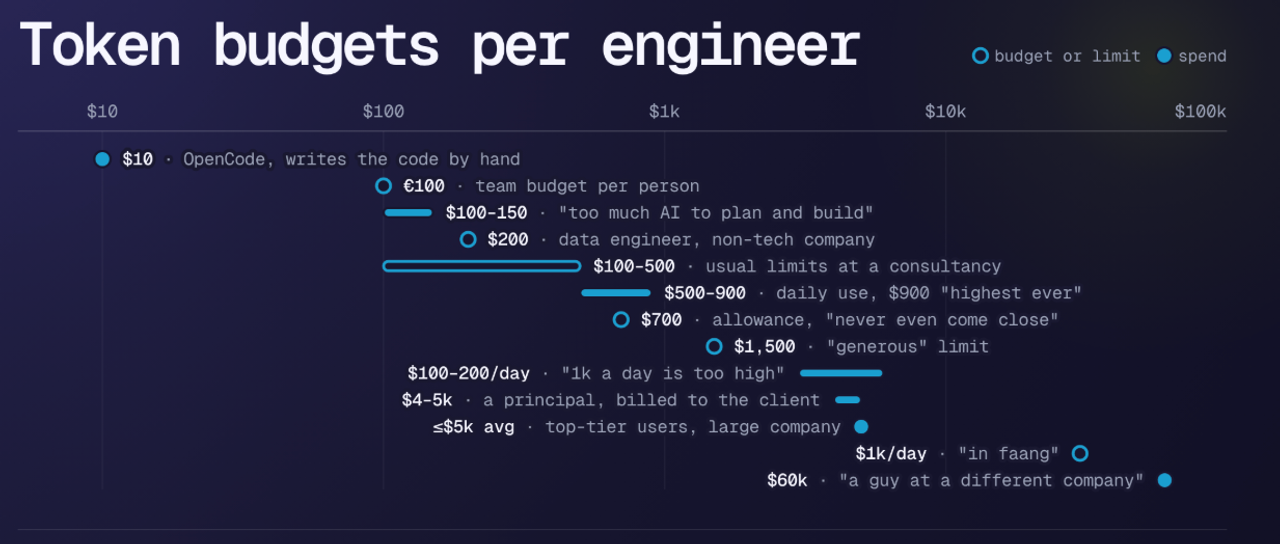
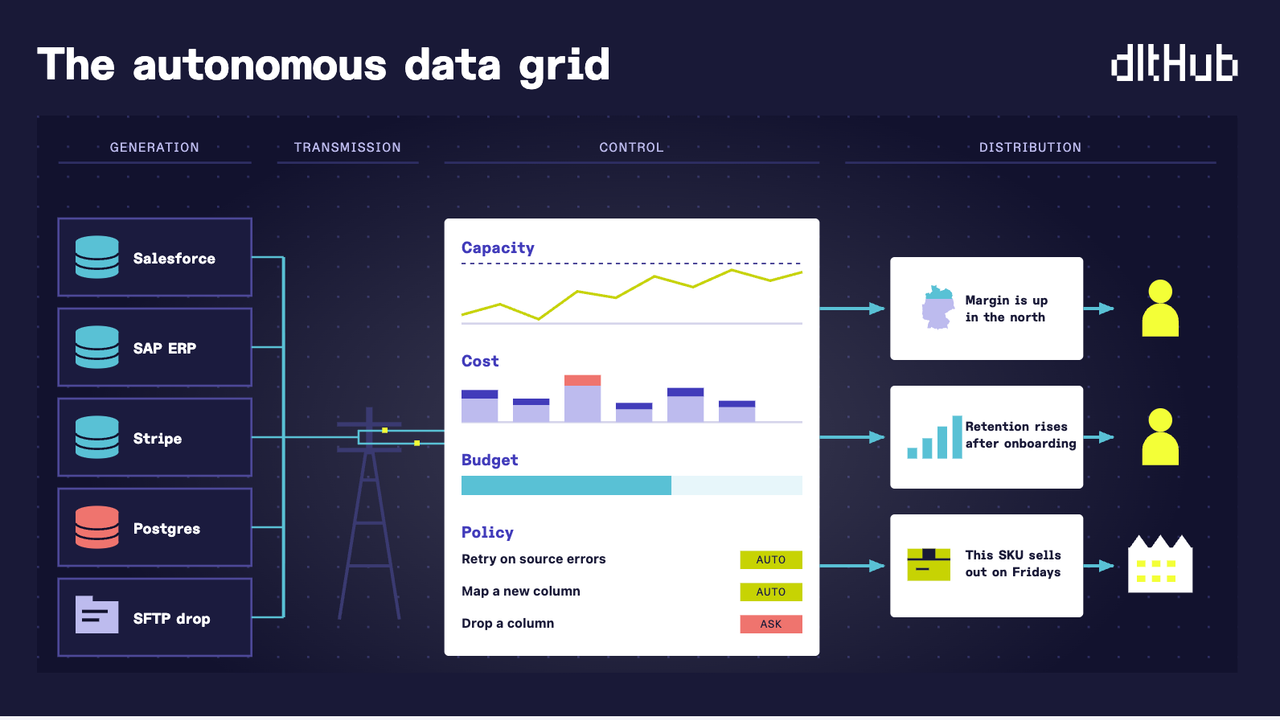
Agents showed up inside companies faster than anyone planned for. The AI bill climbed right behind them. But the bill is a dead end. It arrives as one number. It can't tell you which model ran, which person made the call, or which customer the work was for. Finance can't attribute it. Engineering can't optimize it. The information exists. It lives in the agent traces. But those traces are scattered across thirty-plus vendor formats and over fifty data pipelines that change with every release, so nobody joins them to the bill.
Since launching mid-May we've watched customers build their own version of dltHub, and we've watched customers and partners ask us to build it with them. Each Blueprint is dltHub configured for a specific use case, end to end - from the sources you already use to a production-ready surface. Today we are launching two dltHub Blueprints for agent spend: Agent Cost & Usage to understand it, Agent Distillation to optimize it.
See: what each model, person, and customer costs
Every agent call leaves a trace. The Agent Cost & Usage Blueprint ingests those traces, keeps working as their formats change, and breaks agent spend down by model, by person, and by customer - source, transformation, and dashboard, ready to run in your own warehouse in hours, not weeks.
The vendor invoice is a single number. It doesn't say which model ran, which person or agent made the call, or which customer the work was for. That detail lives in the traces, not on the bill, and nothing joins the two. This Blueprint joins them.
With Agent Cost & Usage, you can answer:
- Total spend over any window, rising or falling. Here, $51,984.11 over six months, latest day down 25.5%.
- Your biggest line item. Claude Code: $21,811.57 of the total.
- Spend by model, vendor, and API. What each one actually costs (claude-opus-4-7, gpt-5.5, Anthropic vs. OpenAI), not just the aggregate.
- Spend by person or team. Which caller is running up cost, and on which model.
- Spend by customer. Cost-to-serve per account, who's ramping, who's quietly churning.
That last cut is where your own warehouse pays off. Cost is half the number; your billing data is the other half, and because the Blueprint runs on your warehouse it can join the two. Put each customer's agent cost next to what they pay and you get margin, not just cost: a customer paying $2,000 a month whose agents cost $2,400 to run is underwater - and now you can see it. An observability tool can't, because the traces and the contract sit in different systems. Only your warehouse holds both.
At launch, dltHub ships pipelines for Claude Code, Codex, and Cursor - point them at your usage data and every breakdown above works, no pipeline to build. Need a source we don't cover yet, or a cut specific to your business? We customise the Blueprint with you.
"Agents showed up inside every company faster than anyone planned for, and every department wants the same answer first: the bill. What is each agent doing, and what is it costing me? That's not a model problem, it's a data problem, the answers live in the traces, every vendor's look different, and the invoice can't see any of them. We caught it early because agents were already using dlt to wrangle it."
Matthaus Krzykowski, CEO of dltHub
Optimize: the first proof of what visibility unlocks
Seeing the cost is step one. The next move is obvious: take the expensive, high-volume agents and replace them with smaller models that do the same job. Same budget, more agents running, more usage for your own customers. And the trace data that answered the cost question is the training data for the cheaper model - so the work isn't duplicated. This is the loop distil labs closes, and the first proof of what visibility unlocks.
distil labs takes the traces a customer is already collecting and distills them into a small specialist model. The traces seed a synthetic data engine: a large teacher model generates thousands of task-specific training examples grounded in the customer's real traffic, automated validators filter out the teacher's mistakes, and a compact open model is fine-tuned on what survives. The pipeline is built for real production traces, which are messy - in distil labs' published benchmarks, even corrupted traces build a 1.7B SLM more accurate than 744B LLMs.
What the customer gets back is a drop-in replacement endpoint, not an ML project. distil labs hosts the model and serves it behind the same OpenAI-compatible API the expensive agent used, so switching means swapping one URL in existing code. Same behaviour on the task, with higher throughput, 50-90% lower inference cost, and lower latency. Setup takes under 30 minutes, training runs overnight, and the model is typically integrated in days. The customer writes no training script, maintains no pipeline, and operates no inference infrastructure.
For any of this to be easy, the traces have to arrive in a usable shape - and that's the half going forward dltHub does. The Agent distillation with distil labs dltHub Blueprint pulls traces from wherever they already live and standardizes them to the OpenAI messages format distil labs trains on. At launch it ships verified pipelines for Arize, Langfuse, LangChain and Pydantic Logfire, and the standard transformation to the distil labs format is included. A customer goes from raw traces to a fine-tuning-ready dataset without doing the plumbing.
"The hard part for customers was never wanting a cheaper model. It was getting their trace data into a usable shape," said Jacek Golebiewski, CTO of distil labs. "With dltHub doing the ingestion and standardization, a customer goes from raw traces to a distilled drop-in model with no script to write or maintain. We've seen a 0.6B specialist trained this way beat its 120B teacher on the target task by 29 points. The traces were always there. dltHub made them usable."
Getting started
Pick a dltHub Blueprint and point it at the sources you already use. dltHub ingests and normalizes the traces into your own warehouse in minutes, and the Blueprint's transformations and dashboard come with it - no pipeline to build.
Both launch Blueprints run on dltHub, from $1,190/month, scaling with consumption. See more details for Agent Cost & Usage and Agent distillation.
For more questions see our dltHub Blueprints Launch FAQ, including
- Why are we shipping dltHub Blueprints?
- Why is this hard? Why hasn't it been solved already?
- Need a source we don't cover yet, or a cut specific to your business? That's how to get involved - bring the problem and we build the Blueprint with you.